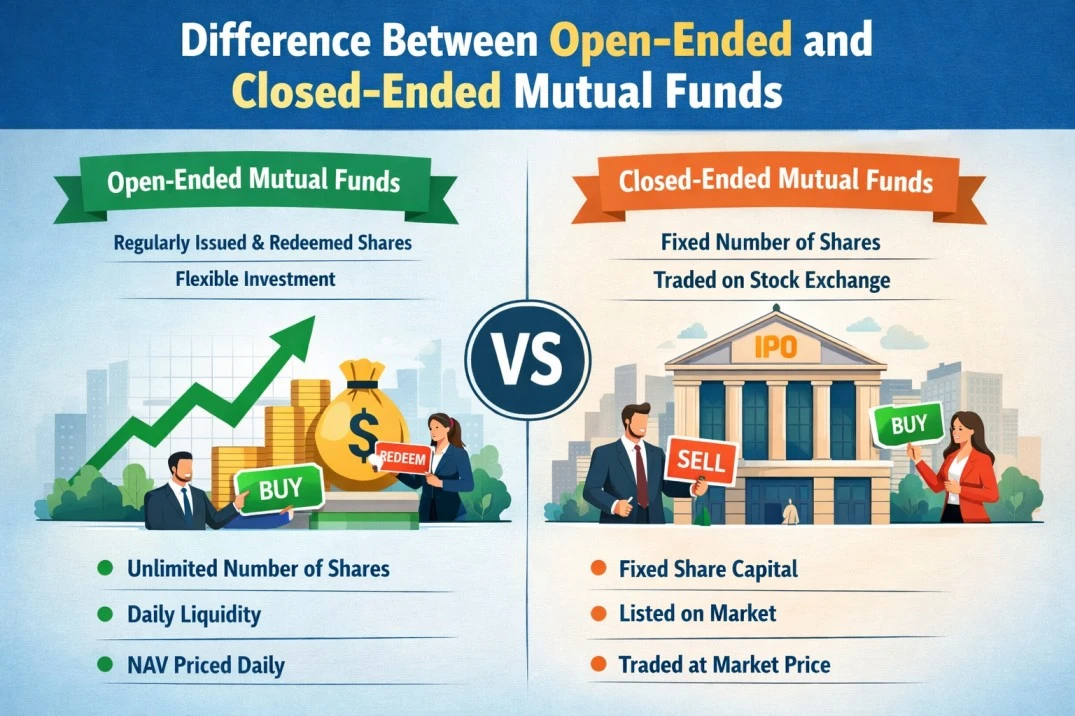
Most new investors start their mutual fund journey by comparing returns, believing that performance alone separates one scheme from another. But as you spend more time understanding how mutual funds actually work, the difference between open-ended and closed-ended mutual funds becomes just as important as choosing the right category. These structures decide how freely you can invest, when you can redeem, and how comfortably your money fits into your financial routine.
For beginners, this distinction often goes unnoticed because both funds look similar on the surface. But once you see how each structure handles liquidity, flexibility, and investor behaviour, the choice starts making much more sense. Platforms like mutual fund wala emphasise this early on because understanding the fund’s structure can help investors align their decisions with their goals rather than market noise.
An open-ended mutual fund stays available for investment and withdrawal on all working days. You can buy or sell units whenever you need, and the transaction happens at the fund’s daily Net Asset Value (NAV). There is no lock-in or fixed maturity, which makes the structure feel flexible and easy to understand.
For a beginner, the simplest way to think about an open-ended fund is this: your money isn’t tied up. You are free to increase or decrease your investment at your own pace, based on your financial situation and market conditions.
In contrast to Open-Ended Mutual Funds, closed-ended mutual funds operate in a more structured manner. It accepts investments only during the New Fund Offer (NFO). NFOs are like Initial Public Offerings for mutual funds, in which mutual funds raise capital from investors to launch a new scheme.
After the fundraiser, it closes to new purchases. Once you invest, your money remains locked until the fund matures. These schemes are listed on stock exchanges but are not liquid due to low trading volume. This means that, even though the fund is technically tradable, selling your units early may not be easy, and the price may not reflect the fund’s actual NAV.
For beginners, think of a closed-ended fund as a time-bound investment in which you invest at the beginning, and the money stays invested for the full term. This structure can be helpful if you want to remain invested without the temptation to exit during market volatility.
Once you understand the basics, the practical difference becomes clearer. Open-ended funds fit naturally into most financial plans because real life demands flexibility. Income changes, new responsibilities arise, emergencies come without warning, and markets move unpredictably. Having the ability to adjust your money easily becomes a meaningful advantage.
Closed-ended funds, on the other hand, remove emotional decision-making by locking the investment. This benefits investors who tend to exit during downturns or struggle with staying invested over long periods. The closed structure can help them ride out volatility and avoid interrupting long-term gains.
Both formats work, and they just support different kinds of investor behaviour. However, open-ended funds are the preferred mode of investment due to the option to invest through SIPs, which help build wealth in the long run.
Most beginners find open-ended funds more comfortable because they fit naturally into everyday cash-flow needs. You can start small, build a habit through SIPs, and make changes as life evolves.
Closed-ended funds may suit investors who prefer committing to a specific time frame and do not want the flexibility to redeem early. Your choice should depend on your finances, liquidity needs, and risk appetite.
Ans: An open-ended mutual fund allows investors to buy or redeem units on any business day. There is no fixed maturity, and liquidity is available throughout the year.
Ans: A closed-end mutual fund accepts investments only during the New Fund Offering and stays locked until maturity. Investors cannot redeem units with the fund before the end of the term.
Ans: Neither is universally better. Open-ended funds suit investors who need liquidity, while closed-ended funds work for those comfortable with a fixed tenure.
Ans: Not necessarily. Returns depend on the fund category, market cycles, and fund management.
Ans: Yes, some closed-end funds are listed on stock exchanges, but liquidity may be limited, and the price may not match the NAV.
Recent Post
General Terms
These terms and conditions (“Terms”) contain important information pertaining to your mutual fund investment account with PP Mutual Fund Services Investment Services Private Limited (hereinafter referred to as “PP Mutual Fund Services”, “our” or “us”). The Terms govern the relationship between us and you, the user (“You” or “Client”). Investment in mutual funds is enabled through PP Mutual Fund Services Investment Services Private Limited, a mutual fund distributor registered with AMFI having ARN – 275889.
Disclaimer
The Client understands and agrees that all investment and/or investment decisions are based on the Client’s own investment objectives and evaluation of prevailing financial circumstances.
Account opening and registration
Before availing of any online investment services on the Platform, the Client is required to complete PP Mutual Fund Services’s registration process.
Account security and passwords
The Client acknowledges that they shall be responsible for maintaining their login credentials in a secure and confidential manner.
Modification of details
Orders
All orders routed through the Platform shall be deemed to have been made by the Client.
Investments in mutual funds
The online platform provided by PP Mutual Fund Services is an order collection platform.
Representations and warranties
Clients represent and warrant to PP Mutual Fund Services that they are eligible to enter into these Terms.
Client account termination and suspension
All intellectual property related to the Platform belongs exclusively to PP Mutual Fund Services.
Third Party Sites
The Platform may contain links to third-party platforms.
Indemnities
The Client agrees to indemnify and hold PP Mutual Fund Services harmless.
Investment advice
None of the services available on the Platform shall be deemed to be investment advice.
Programmes & Initiatives
Force majeure
PP Mutual Fund Services shall not be responsible for delays beyond its control.
Severability
If any provision becomes invalid, the remaining provisions shall remain unaffected.
Miscellaneous
All services are provided on an “as is” basis.
Governing Law, Jurisdiction and Dispute Resolution
The Terms shall be governed by the laws of India.
Contact Us
Please reach out to info@mutualfundwala.radiantaccessories.in if you have any questions or concerns.
Privacy Policy
In the course of using this website or any of the websites under the ‘PP Mutual Fund Services’ domain or availing the products and services vide the online application forms and questionnaires, online consents and such other details required from time to time on any of PP Mutual Fund Services’s (and/or its affiliates) web platforms or mobile applications, PP Mutual Fund Services and/or its affiliates may become privy to some of Your personal information, including which may or may not be of confidential nature. PP Mutual Fund Services is strongly committed to protecting the privacy of its users/clients and has taken all necessary and reasonable measures to protect the confidentiality of any customer information.
For the purpose of these Privacy Policy, wherever the context so mentions “Covered Persons”, “Client”, “You” or “Your”, it shall mean any natural or legal person who has visited this website/platform and/or has agreed to or has enquired to open an account and/or initiated the process of opening an account with PP Mutual Fund Services.
Scope of this Policy
Any natural or legal person who has visited the PP Mutual Fund Services website/platform and/or the mobile application, and/or who may or may not have further agreed to initiate the process of opening an account with PP Mutual Fund Services shall come under the purview of the scope of this Privacy Policy.
Collection and use of your personal information
PP Mutual Fund Services may collect your Personal Information to provide services on its web-based platform or mobile application. While opening an investment account, you may be asked for Sensitive Personal Data to complete your KYC as per AMFI and applicable laws.
We collect Personal Information only when you voluntarily use our services or initiate the account opening process. All such information is used for identity verification, regulatory compliance, service personalization, and audit purposes.
Aadhaar user consent policy
Providing Aadhaar is voluntary and is required only for completing online account opening and digital signing. You may alternatively choose offline account opening without sharing Aadhaar information.
PP Mutual Fund Services may also collect non-personal information such as IP address, browser type, ISP details, pages visited, and time spent on the platform.
Cookies may be used to improve your browsing experience. No personal information is stored in cookies.
Disclosure and transfer of collected information
PP Mutual Fund Services does not sell or rent your personal information. Information is shared only for regulatory compliance, service delivery, or with your explicit consent.
Security
We use industry-standard security practices such as SSL encryption and secure servers. However, no method of transmission over the Internet is completely secure.
Your data is transmitted using HTTPS encryption. Please ensure your login credentials remain confidential.
Correction / Updating or Access to Personal Information
You may update or correct your Personal Information at any time or unsubscribe from communications if you no longer wish to use our services.
Google Mandated Disclosure
If you authorize Google to fetch your electronic Consolidated Account Statement, PP Mutual Fund Services’s use of such data will strictly comply with the Google API Services User Data Policy, including Limited Use requirements.